
Should You Join a Group Practice or Go Solo?
Demystifying job listings, fee splits, corporate group practices, third party practice supports, and factors to consider before making a decision.

This post is for the therapist who wants to work in an outpatient, private practice type of environment, but isn’t sure about being a small business owner just yet. You’re stuck between joining a group and striking out on your own. Some days, you think you could do really well as a solo practitioner, and would love to be your own boss. Other days, that sounds incredibly unstable and overwhelming.
I can’t make your decision for you, but I can help you understand key factors to consider, various group practice structures (so you know what you’d be getting into ahead of time), and generally what to expect either way. Let’s demystify this process together.
Key factors to consider
Working at a group or in solo practice can both be really rewarding, and both can be long-term options. You need to reflect on the specific factors that will make the biggest difference for you.
Legal Factors
If you’re an associate therapist working under supervision, the first thing you need to check is whether your state allows you to start a solo practice. Not every state does. Always need to make sure you’re practicing legally.
Autonomy
Having autonomy over your caseload, schedule, and practice policies is usually one of the main factors that therapists are considering when choosing any kind of private practice setting. Obviously, a solo practice gives you the most autonomy. But, that comes with the most responsibility and potential for mistakes as well. Starting a solo practice means starting a business.
Ensure that you are ready to put the ongoing time, money, and cognitive investment into things like business planning, accounting and taxes, marketing and client acquisition, and administrative responsibilities. If you’re feeling overwhelmed by the idea of these tasks, that doesn’t automatically mean a solo practice is off the table. But I would recommend consulting with a business or private practice coach to get more clarity on what is going to be required to do this well. If you know you only have minimal time for these tasks, or you really don’t have any interest in owning a business, a group practice is probably a better option for you.
Within the group model, there is still a wide range of autonomy offered. When looking at job listings, consider things like…
minimum caseload requirements: Does the practice require you to see a certain number of clients per week? Many do to help ensure that you’re working enough to at least cover the basic expenses you’ll incur. But that requirement can vary a lot, so make sure you’re clear on the expectations.
working hours: A remote or hybrid group might allow you to have total control over your schedule, but an in-office group might be more restrictive based on when office space is available.
client assignments: How much control do you have over the clients who get assigned to you? Some practices do very tailored matching, others tend to just assign clients to whoever is available.
level of admin support: Are admin staff present to take calls and inquiry emails, manage practice troubleshooting issues, handle billing, etc? Or are you doing that?
While there are other details that can speak to levels of autonomy here, they all kinda feed into this general equation. The closer you are to functioning like a solo practitioner, the more money you should make. If you receive a lot of support and pay for fewer business expenses, you should expect the practice to keep more of the fee split.
Season of Life
Where do you want work to fit into your life right now? Do you want to grow a business? Do you want to just show up to work? Do you have the time to dedicate to running a practice? Do you need to learn a bunch of new skills before you could run a practice? Could joining a group first be a great way to learn some of those skills? Does it make sense for you to start your practice on the side while working a full time job, or do you want to jump in head first?
Ultimately, this is the kind of career that has to make sense with your life. It’s already hard enough to be a therapist. If you want to do this work for the long haul, you need to make your job work with your life as much as possible. Reflect on what that currently means for you.
When I re-opened my practice in 2023 (I had originally opened it in 2019, and then closed it in 2021), I was coming out of maternity leave. I had the business skills to run a solo practice. I also just like managing my own stuff. I don’t like other people running my calendar or answering my client inquiries. I just have my way of doing things. I knew I wanted a part-time caseload. I also knew I wanted to spend as little time on unpaid admin work as possible, which is why I ultimately went with a business model that included taking insurance and doing a lot of outsourcing. If I didn’t already have those business skills from my first round in private practice, joining a group probably would’ve been a better option for me at that time.
Community and Support
Solo practice can be really isolating and lonely. For some people, that’s not an issue, and even welcome. For others, it’s a dealbreaker. With all of the remote work options, it’s important to remember that you can work at a group practice and still feel pretty isolated. It’s all about the individual place you work. And there are plenty of ways to get connected to your local therapy community if you’re a solo practitioner. But if your season of life is going to make it really hard for you to intentionally connect with others, and you want that, it might be important for you to look for a job with some built-in connection. And of course, if you are needing supervision, you need to prioritize that.
The downside of community is the drama. Oh yes, my friends. Group practice drama can be intense. You put a bunch of feely people in an intense job together who don’t always know how to communicate the hard business stuff without taking it personally and phew it’s a lot sometimes. Team dynamics, turnover, and staffing concerns are easily the most stressful part of the job for group practice owners, and that stress can trickle down to the rest of the therapists when it’s not handled well.
Risk/Reward
When you’re the sole owner, it’s all on you. For better or worse. That means all the profits go to you, so there is potential for a higher income once you learn to streamline your expenses. You only have to worry about yourself, and that’s nice. Your admin tasks generally don’t get that complex, even if there are a lot of them.
All the mistakes fall on you too. The burden of getting clients is totally on you. You can’t rely on someone else to figure out where else to find clients if your Psychology Today profile isn’t getting any hits. If you can’t get clients, you don’t have a practice. If you mess up your taxes, the bill is yours alone.
For some, that risk is just too much to mess with, and that’s understandable. In general, if you’re at a group practice, the range is just more narrow. You assume less risk, because the group owner is assuming some of that risk for you. But your income potential only goes so far too.
Ethics
We’d love to assume that all group practices would hold the same ethics as us, but you just can’t assume that. The rise of venture capital and corporations in mental health have changed the landscape a lot in the last several years. I’m not saying that all the corporate mental health companies are bad. And I’m never going to judge a fellow therapist who needs to work at one. We gotta pay bills and eat. My general advice? Sleep with one eye open and your bag packed. You just never know.
Generally, a local clinician-owned group practice will probably be more clear about their values, and likely more aligned with your own values as a therapist. And that being said, they’re not immune to bad decisions either. People’s ethics and values can change when they are incredibly stressed, responsible for a lot of people, dealing with a lot of money, and things aren’t working out as planned. And good therapists aren’t necessarily good business owners. It’s just the reality. Remember that no company has a therapy license. You do. You have to protect that.
Money
I saved the longest for last: money. It’s easy to compare job listings and think- this one says $100 an hour and this one says $45 an hour. Obviously the $100 is better. Well…. maybe. Sometimes that’s true. Sometimes, it’s a corporate group practice being kinda shady in how they’re marketing their job listing.
The first thing to know is this: most job sites are pretty plug-and-play. They don’t let you say “$ per session” instead of “$ per hour.” You have to learn how to interpret different types of therapy job listings, because you’re often comparing apples to oranges. Salaries are pretty straightforward, of course. Some group practices do offer W2 full-time and part-time salaries. The next thing you might see are full-time W2 hourly rates. These are the ones that usually look pretty low. That’s because they are true hourly rates, for 40 hour work weeks (or whatever the FTE is). After that, group practices usually structure wages in one of these ways:
pay per session only, which is often a fee split (X% to the group, X% to the therapist). You’ll make more each hour, but get paid for fewer of the hours you actually work. This is the most similar to a solo practice.
pay one flat rate for sessions, and a different flat rate for administrative/non-clinical work. The clinical rate will be less than the (1) fee split, because you’re also getting paid for admin work.
a hybrid of the two- fee split for sessions, and a flat admin rate
A fee split means that you might not make the same amount for every session. If you take multiple insurances, the rates will vary. Even if the practice is private pay only, there could be multiple rates available (sliding scale, couples vs. individuals, etc.). This is where the advertised pay rates get really confusing, because practices will often list the whole range.
This is also where some of big third party private practice services, like Headway, Alma, Rula, etc. try to get you really interested in them because their rates look way better. They look better because these are services that support solo practitioners to credential with and bill insurance (they support groups too, but if you’re not the group owner, don’t worry about that). They are advertising the gross rates you will receive from insurance reimbursements - pre-tax (all jobs advertise pre-tax rates) AND pre-business expenses. So yes, they’re better up front. They may not be better by the time that money trickles down to your personal paycheck.
Demystifying Real Job Listings
Let’s break down a few real job listings, currently on Indeed. I searched like I was looking for myself: “licensed professional counselor” in the Denver, CO metro area. I filtered for outpatient and private practice openings.
1. Private Pay Group Practice
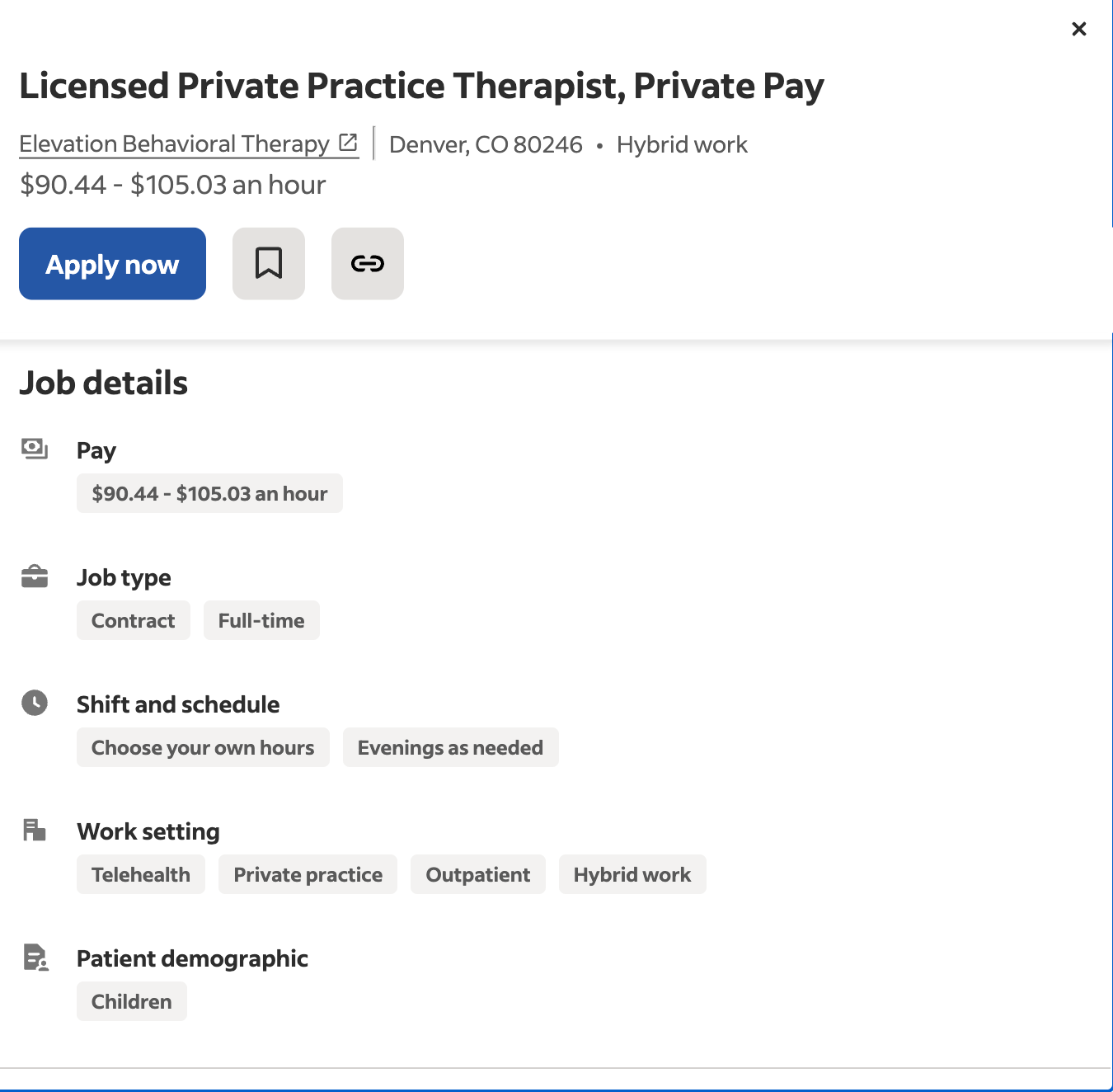
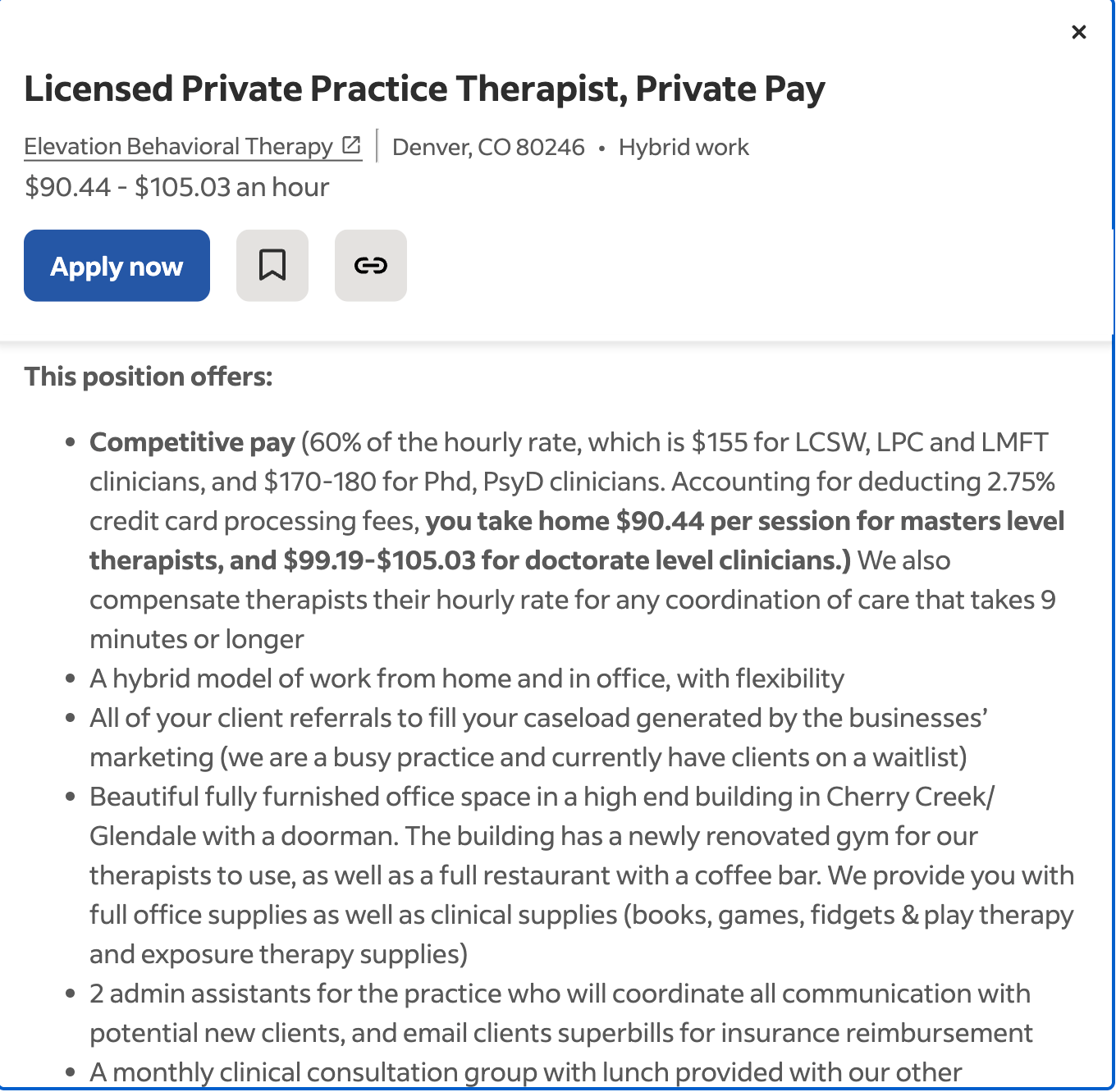
This is a listing for a local group practice that does not take insurance. It’s a 1099 contractor role. That’s a little confusing since both “contractor” and “full time” are listed- my guess is that it’s 1099, but they have enough client referrals to fill up a therapist’s caseload to full-time if they want. It’s a 60/40 split, which is clearly stated in the listing. That’s a fairly standard split. They provide office space, office and therapy supplies (such as the EHR and telehealth system), administrative/billing support, and a consultation group. They also pay the hourly rate for admin, which is pretty nice.
If I were interested, I’d first make sure my clinical goals align with the practice’s specialties. I’d also want to ask about caseload minimums and the “evenings required” part. A lot of groups will want you to work evenings or weekends at least occasionally. If I worked here as an LPC, saw 25 clients a week (private practice standard for full-time), and spent another 10 hours a week on admin time, I’d make $3165.40 a week before taxes. Remember that you probably wouldn’t get PTO or sick time, and you likely don’t get paid for cancellations (potentially for no-shows but that’s not listed). Your wages are basically like a solo practitioner- you make money if you’re working.
2. Insurance Based Group Practice
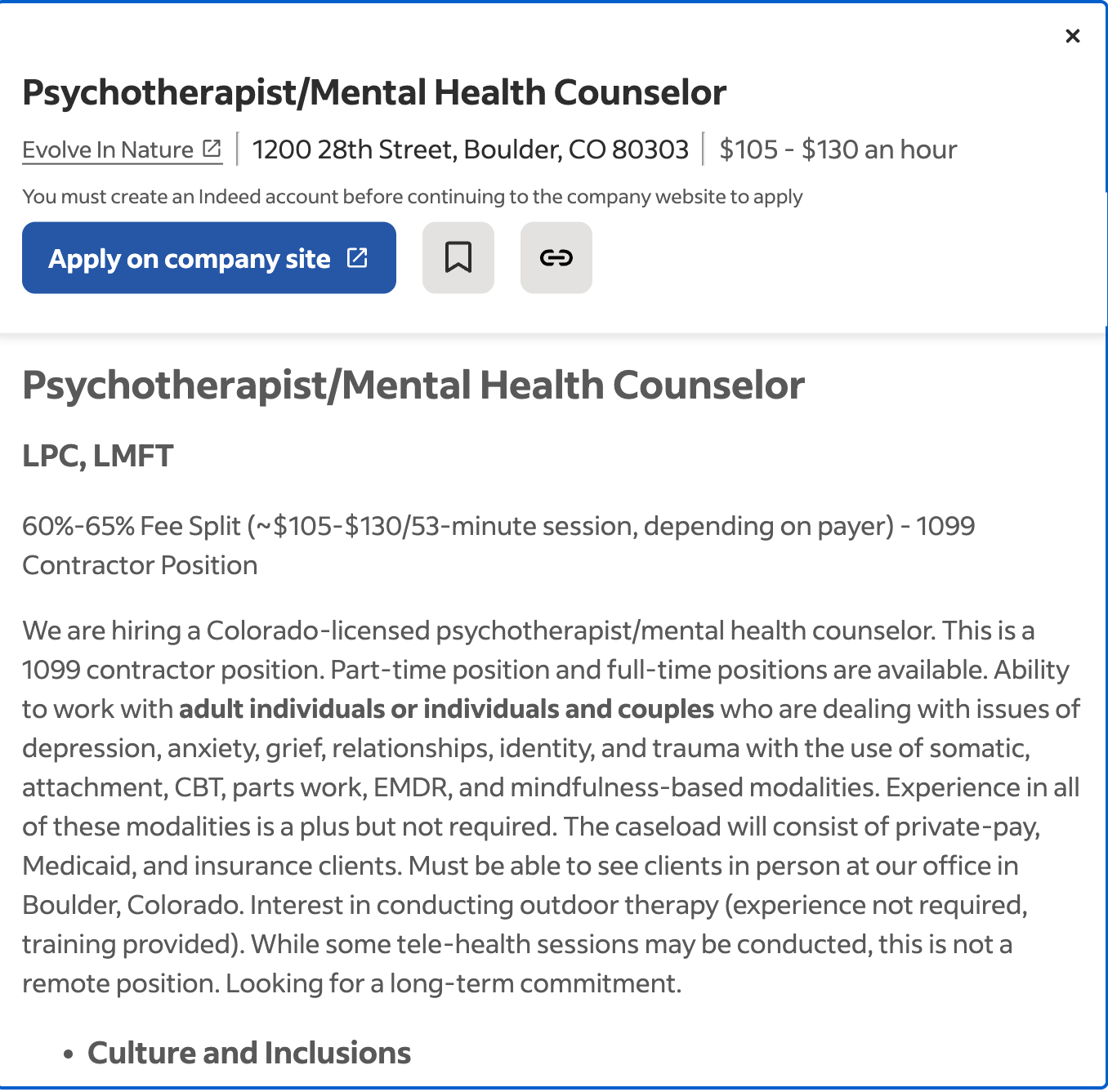

This next one is for a group practice that takes insurance. It’s also a 1099 position, and also offers a 60-65% split. However, the rates are noticeably higher, ranging from $105-130 per hour. The range exists because of the varying reimbursements of the insurance payers and the practice’s private pay rate. They also provide office space, and do require clinicians to be in-person the majority of the time just from the listing info. They list the various modalities and populations they focus on, and who they’re interested in hiring. Noting the weekly consultations and in-office emphasis, it sounds like this practice would also offer a collaborative feel. It doesn’t note anything about an admin rate, so maybe they offer a lower rate for that, maybe you get paid for sessions only.
If I were interested, I would also ask about minimum caseload requirements, and their referral volume/general timeline for building a caseload. I’d also ask about the note about “opportunities for higher fee split” and what those opportunities are.
If I worked here as an LPC, seeing 25 clients a week, averaging $117.50, assuming there is no admin rate, I would make about $2937 a week, but I could make anywhere from $2625-3250. Same rules as above regarding PTO and cancellations.
3. Corporate Group Practice
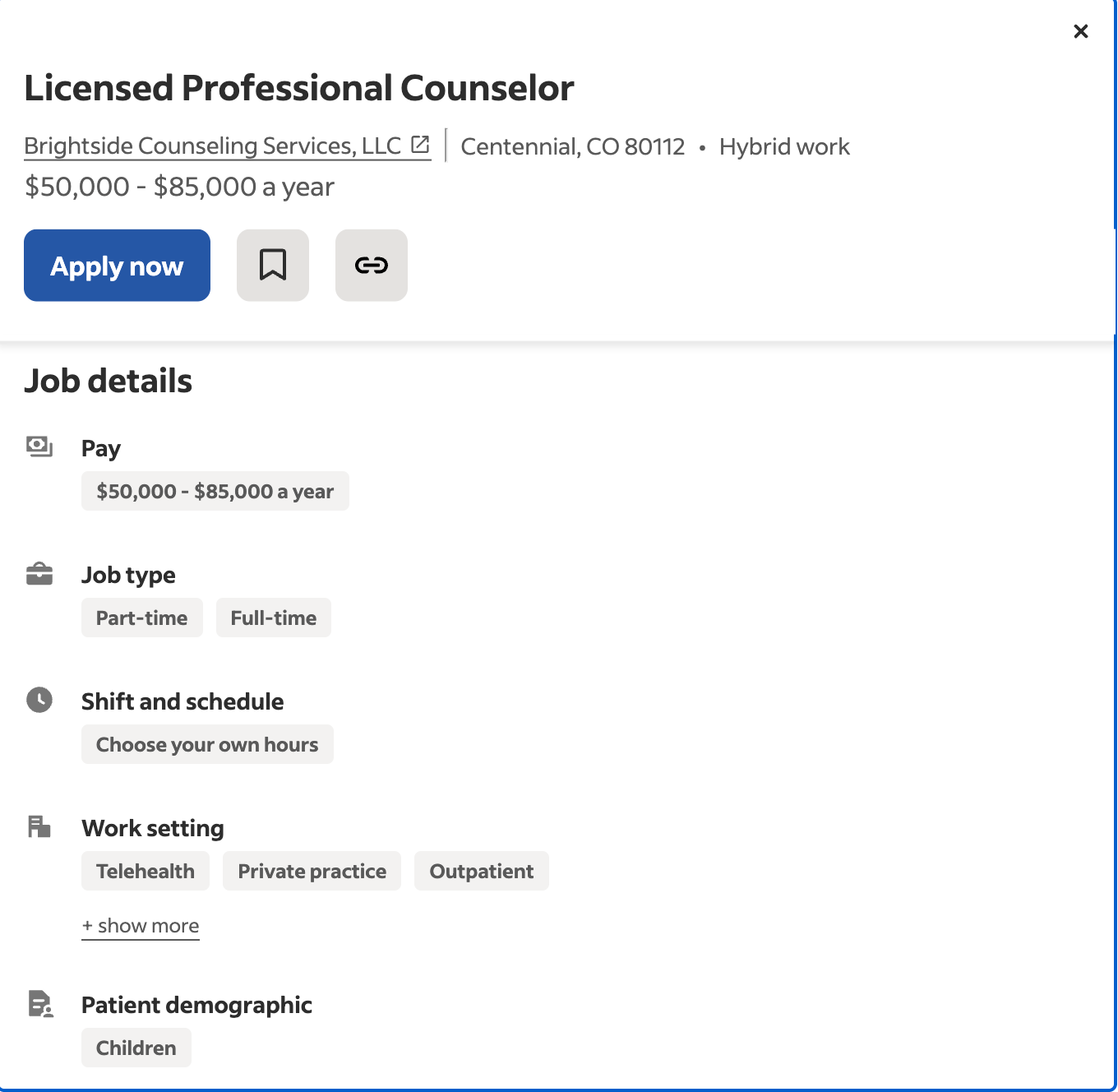

Brightside is a corporate mental health company that focuses on children and adolescents. Working at Brightside as a therapist generally means working in one of their counseling centers, which are located all over the country. So it might feel like a group practice some days, but it is definitely Corporate. That means you’ll probably have a lot of admin and billing support, and lot of expectations coming down from who-knows-where. Less autonomy for sure, but more stability in some ways. You show up and do your thing, they take care of the rest.
They are offering a W2 salary. I’m guessing the $50k is for part-time, and the $85k is the high end of the range for full-time. They list the hours, but this is where you need to read between the lines. I would bet money that 15 hours a week is not 15 working hours- it’s probably 15 client hours for part-time (and 20 total working hours), and 30 client hours for full-time (40 total working hours). That’s very much on the high end for productivity requirements, as most corporate mental health companies are.
This position comes with health insurance, 401k, and professional development assistance, which probably means a stipend for CE’s and/or license renewals. Without doing more research, it’s hard to say how good the benefits truly are, but they exist, which is more than a lot of local groups can offer.
So, how do you compare $85k to $117 or $90 an hour? You need to get a sense of how those hourly rates translate into your take home pay, and an actual salary. Let’s say the $85k jobs come with 2 weeks vacation per year (I have no idea what’s actually included). So $85k is for 50 weeks of work per year. That means the job in Boulder is $146,850 for 50 weeks per year. Sounds way better, right? Yes, but no one is paying your taxes or other expenses. I used this income tax calculator to get a very rough estimate, using a single filing status for someone in Colorado. After taxes, the salary is $104k. How about the Denver job, at $90 an hour? With the same calculations, the yearly salary would be $158k. After taxes, it came out to $112k.
Now, both of the group practice salaries are still inflated. You’re likely going to take more than 2 weeks of vacation/sick time, and that’s all unpaid time. You also need to consider cancellations. Yes, many practices charge for late cancellations and no-shows. But most don’t for cancellations that are made in advance, and unless you or the practice are savvy about booking those slots with a cancellation list, you’re going to have openings here and there. The reported average I usually see is around 10%. My personal average is about 5%, but that is with a pretty established (and small) caseload. So let’s do more math, this time with 4 weeks of time off (48 working weeks), minus an additional 10% total income to compensate for cancellations.
Now, the Denver job’s salary is $98k, and the Boulder job’s salary is $92k. You may have other business expenses to cover as well, since you’re a contractor. Unless you have a partner who covers you under their health insurance, you’re paying for that too. And don’t forget a retirement account. So honestly, the salaries suddenly aren’t that different. However, you’ve got twice as much vacation, a smaller caseload, and are working for a local person instead of a corporation. I’d still choose either of the group practices over the corporate mental health job. But just know that if the corporate mental health jobs are the only ones available in your area, don’t feel like you’re picking up scraps vs. these rich people group practices. Once you really do the math, it’s not the case.
4. Solo Practice Partnering with a Third Party

Finally, we have a solo practice option. This one is for Headway, and it’s more an ad for a service than a true job listing. You’re not competing against other candidates. If you meet the qualifications, you’re eligible to join their network. Headway is one of several companies that provide credentialing, billing, and basic EHR services to private practitioners to make the process of working with insurance easier.
So what is the hourly rate? How is this a job listing? Well, what this really means is that Headway’s current contracts in Colorado are offering reimbursement rates between $90-127 per session, presumably. So if you sign up with Headway, as a licensed therapist in Colorado, you’d make somewhere in that range per session, depending on which insurance plans you panel with and which plans your clients have. This is your gross pay as a small business owner, so pre-tax and pre-business expenses. A good rule of thumb when you’re completely on your own is to expect to actually take home around 50-55% of your gross pay if you’re a sole proprietor or an LLC. If you become an S Corp, that’s a whole other thing that deserves its own post.
The difference here is that you could see 25 clients a week at $127 per client, or 5 clients a week. You have more flexibility here than you would at a group practice.
Let’s do more math. If we took the average again ($108), at a full-time caseload, working 48 weeks a year, with a 10% cancellation rate… you would gross $116k. Now it just depends on your tax status and how well you streamline your expenses.
Final Thoughts
Despite how long this post was, it’s really just scratching the surface of what to think about when choosing a group or starting your own practice. But I hope it gave you some things to consider, especially around understanding what you’d actually be getting paid at these jobs, and provided some clarity.
Want to talk more about your individual career path? I’d love to chat. You can reach out for a consultation through my website, Ivory & Pine Counseling.
This is FIRE. Thank you. I'll be sure to support at some point for some time. Have to kill another subscription or two first.