Competence in diagnosing is generally considered to be an important and foundational skill for any therapist. Learning the DSM and psychopathology is often a major part of our education in grad school. Every insurance claim for therapy requires a diagnosis. Psychiatric meds are largely based on diagnoses. Many people’s presenting concerns in therapy are diagnosis or symptom related. And colloquially, we refer to mental health diagnoses all the time.
But there is also growing awareness in the profession and in the mainstream population of the limitations of the DSM and critiques of the system it has helped create. These critiques range from the biased perspectives that contributed to the DSM, to frustrations with its fused identity to insurance claims that often limit access to care rather than improve it, to the narrow and incomplete views on what qualifies as pathology while simultaneously over-pathologizing the human experience.
So what should we make of diagnosing? Is it truly so important for new therapists to learn? Is this just the way it is? Is there another way to look at it?
Like most things in mental health, I don’t see diagnosing as a black and white issue. It’s not solely good or bad. It’s not as simple as accurate or inaccurate.
I try to take a pragmatic view on diagnosing. It’s entrenched in the system we work in. We can’t fully avoid diagnosing, even if we completely oppose the whole system. So I generally think it is much better to be well educated and skilled in this area than to pretend it doesn’t exist, even if you run a cash pay practice your whole career. But I also think that being overly invested in this particular brand of diagnoses and psychopathology can do a disservice to our clients and our understanding of human psychology as well. For me, it all comes down to this question: when is having a DSM diagnosis beneficial for the client?
I’ll break down how I determine this for the remainder of the post. Please understand that these are my views alone. I have drawn from 10+ years as a therapist immersed in this world, from my education, and from others’ research. Many therapists have more expertise than me, and I by no means claim to hold the “right” view on diagnosing. I hope this post can simply give you some food for thought.
A little more on critiques of the DSM
If you are unfamiliar with the origins of the DSM or why it might be critiqued by professionals in the field, here is a quick synopsis.
The DSM was originally created in the 1940s out of the need to classify disorders affecting military veterans in the WWII era. The first two editions were largely based on psychoanalytic (aka Freudian) theory and early efforts to gather data on mental illness to standardize language, such as the 1918 Statistical Manual for the Use of Institutions for the Insane. Pretty bleak. The first edition of the DSM was published in 1952 by the American Psychiatric Association. First key that it might be missing some data - American. The DSM is not a classification system based on global data.
Early editions were not really based on research at all, but rather on prominent theories of the time. And as mentioned, the first populations to be studied were veterans, who were almost exclusively men in the two world wars. Academic research contributing to the DSM has generally been done by white male academics in privileged university settings, studying young white academic men who were also in those privileged university settings.
The DSM-III, published in 1980, introduced a more evidence and research-based approach. This was probably the biggest shift from one edition to the next that we’ve seen with the DSM. That research-based approach has gradually evolved to what we have now. Today, the DSM-5-TR is a 900+ page manual covering both categorical and dimensional diagnoses. That being said, it is still far from perfect. While many improvements have been made, the reality is that the DSM is based in the same western, patriarchal, white-centered, cisgender and heterosexual-centered roots as many of the other facets of our medical system.
Current offerings:
Newly Licensed Therapist Group: for therapists who are independently licensed, but would appreciate extra consultation and support from a seasoned supervisor without the commitment. We talk about cases, random clinical topics, building a practice, navigating the mental health system, life as a therapist, and anything in between. We meet once a month on a Monday at 2pm ET/12pm MT. Next two meetings are Feb 23 and March 30. Free/donation based. Reach out to me through my website to join.
My therapist resource shop has practical, done-for-you tools to support both your clinical work and the administrative aspects of your practice, as well as recorded clinical trainings available on-demand.
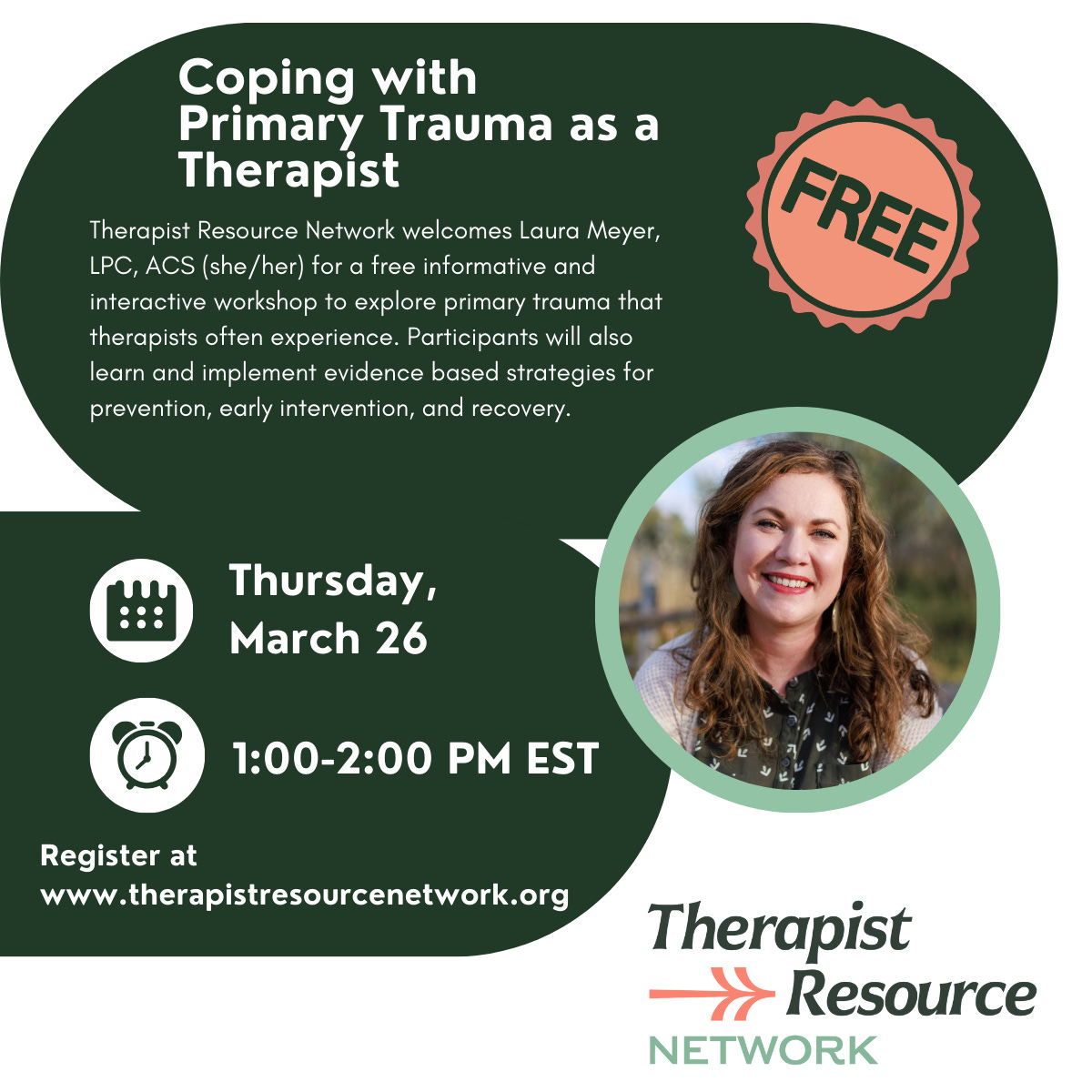
I’ll be speaking on navigating primary trauma as therapists as part of the Therapist Resource Network’s current speaker series!
When does getting a diagnosis right matter?
First, let’s define what I mean by “getting a diagnosis right.” By this, I mean identifying a DSM diagnosis that aligns very closely with a client’s symptoms and lived experience. I do NOT mean having a complete understanding of the true etiology and/or manifestations of a person’s presenting concerns, symptoms, or personality patterns.
This is an important distinction, because we can’t assume that defining a DSM diagnosis means truly understanding the entire picture. It’s a relative standard. Sometimes, DSM diagnoses do fit well with a person’s lived experience. Other times, there simply is not a named diagnosis that truly describes what someone is going through. Or perhaps the person is going through human experiences that shouldn't be pathologized at all, but would still greatly benefit from therapeutic support.
My basic rule of thumb for when getting a diagnosis right matters is this: if the specific diagnosis will have a major impact on the client’s care, make sure it’s as accurate as possible.
The right diagnosis might benefit the client through increasing their options for care, supporting accommodations, tailoring treatment approaches to the client’s needs more effectively, or by providing them with clarity and validation of their lived experience. It might also benefit the client simply by providing the information necessary to get their services paid for, although I would argue that in many situations, getting it exactly right is not necessary for this purpose.
Some examples of “getting it right” situations:
The client is specifically requesting diagnostic clarity.
There is a treatment approach with significant research and efficacy for a specific diagnosis, and having that diagnosis will inform treatment effectively.
The client is also in need of a medication evaluation and/or management, specifically if a change in diagnosis would also change the med regimen or prompt other interventions.
Most accommodation requests: IEPs, FMLA, SSDI applications, any work accommodations, etc.
If the client needs a particular diagnosis to qualify for other interventions that would benefit them
In these kinds of cases, diagnostic data can be a significant informant of how to move forward with treatment. And if that treatment is genuinely going to benefit the client and make a significant difference in their life, we should do our very best to get it right.
Getting it right means diving into the client’s symptoms, history, past trauma, motivations, exception conditions (when does this not occur?), frequency, duration, and onset of symptoms; family and cultural history, medical background, etc. It means comparing and ruling out diagnoses that are similar to choose what specifically aligns with the client’s life and current presentation most accurately.
When does the diagnosis not matter as much?
If the diagnosis will not meaningfully affect treatment or the client’s access to care, or if particular diagnoses could actually harm the client, it might not be essential to match symptoms up exactly to the DSM. This might mean that you don’t diagnose at all, if you have that freedom. Or it could mean that you don’t need to stress about getting it exactly right: all the subtypes, specifiers, severity, rule-outs, etc. You may be fine getting the diagnosis in the right ballpark simply to satisfy insurance requirements.
A few examples of this kind of situation:
The client is not using their insurance benefits for therapy and you both have a good idea of their presenting concerns and clinical needs, whether they have an exact label or not.
The client has experienced healthcare trauma in the form of receiving stigmatized and potentially inaccurate diagnoses in the past, being overly pathologized, or getting dismissed by healthcare professionals.
A particular diagnosis would negate the client’s cultural background, lived experience, and/or values. An example here is a client who speaks about supernatural or paranormal experiences, and immediately giving them a psychotic diagnosis, rather than assessing all other pieces of their background and leaving space for the possibility that they have actually had those experiences.
The diagnosis, even if accurate, won’t make a big difference in the client’s life. An example here is an adult who suspects they are autistic but has never been diagnosed. If the client isn’t planning on requesting accommodations or pursuing other treatment options as a result of getting an official diagnosis, do they truly need to be referred to psychological testing, especially if they would have to pay for it out of pocket or simply don’t want the assessment? I would defer to the client’s preference and autonomy and not push for a formal assessment.
The client is sort of in between a few differential diagnoses. But regardless of which one is most accurate, the treatment approach and potential helpful medications (if applicable) remain the same.
The client’s diagnosis is just there for insurance purposes. Perhaps it’s a reported diagnosis from the client’s history, or one that is well managed. Whatever the case is, the diagnosis is not really the client’s presenting concern.
In these cases, I assess the client’s symptoms and history to get to a general diagnostic category that fits, such as depressive disorders or anxiety disorders. After that, I tend to see what the minimum criteria is for an applicable diagnosis in that category. I find what fits best and move on.
If the client could maybe fit the criteria for two different diagnoses, I go for the easiest one. Find the lowest common denominator. You may not need to dive into all the history and etiology and nuances in order to provide an accurate diagnosis and effectively work with the client. Basically, don’t spend all your mental energy on something that the client doesn’t actually need or care about that much.
Is this morally ambiguous? Am I documenting inaccurate data?
I’ll answer the second question first. I don’t document inaccurate data or make up symptoms. I simply pay attention to the client’s experiences, history, and symptoms and recognize that different people use different language to describe their experiences. Maybe I need one more criteria to make GAD work, and today I realized that my client does tend to be a little restless and fidgety in session. Sounds like “restlessness, feeling keyed up or on edge” to me. Do I need to dive deep into a particular assessment or grill the client for the “right language” to see if the client’s experience of restlessness is clinically significant enough for me to add the symptom? Nah.
First of all, the vast majority of diagnostic criteria in the DSM are relative and/or subjective. Second, we just discussed a few of the reasons why the entire diagnostic system is pretty flawed in the first place. It’s not pure objective science by any means. Third, if that tiny detail is the difference between the client getting a diagnostic code that requires insurance to cover their mental health services or not, I’m giving them the diagnosis.
This leads back to the first question. Is this behavior morally ambiguous? In my opinion, no. You have to make your own decision based on your professional ethics and risk tolerance. But this is my thought process.
We (mental health professionals) are stuck in between two completely opposed systems: clinical ethics and a profit-driven insurance system that does not give a shit about any patient ever and makes numerous billions annually off of our collective sickness and individual providers’ labor. I know where my loyalties lie, and I have zero issues being a little flexible with a diagnosis so my client can continue to access care. It’s all about the translation from the work that happens in session to the clinical language necessary for documentation.
Personally, I am well aware of the exploitative nature of the therapist-insurance payer relationship. I continue to take insurance, and I have my own reasons why, but I do not pretend that it is a mutually beneficial partnership. They treat us with absolute contempt, disdain, and disrespect. Why should I stress over documentation that will be reviewed for 0.2 seconds 95% of the time?
Yes, my documentation is always prepared for audits. But I understand that the audit process is based entirely on documentation meeting their arbitrary standards for compliance. They don’t call the client to testify whether their symptoms exactly line up with what I wrote. They don’t ask the client if the treatment they’re receiving is medically necessary and why. It’s all just a complicated, rigged game. I simply play accordingly. I give them the documentation they want. My clients access their benefits. I provide them with medically necessary clinical care. I sleep just fine at night. Take that however you like.
What should new therapists focus on learning?
I recognize that you may need to learn additional or different information for the purpose of licensing exams. This is what I would focus on if you’re a new clinician or student who has been thrown into the real world of clinical work and is feeling overwhelmed with the amount of information to learn.
Memorize general diagnostic categories and key symptoms that can help you quickly get to the right ballpark when you’re assessing a new client. You can always review the DSM criteria in real clinical settings. You don’t have to memorize those 900 pages.
Focus on the most common diagnoses seen in your work setting. Yes, of course, your work setting will likely change at some point and you’ll need to expand your knowledge base. But when you’re brand new, focus on what matters most right now and get comfortable with that.
Develop your own “decision tree” to help you determine how much energy you need to spend on a particular client’s diagnosis. You might approach it in a way that’s similar to what I’ve discussed. You might prefer your supervisor’s approach. You might develop something totally different. But give yourself a critical thinking framework to help you navigate this area. It’s easier to have general guidelines than to try to memorize the answer to every possible circumstance.
If you do work in a setting where accurate diagnoses are a common part of the work, honestly don’t stress. You’ll learn so much from your colleagues and get really good at this stuff doing it every day. Just continue to absorb everything that you can.
Despite my obvious frustrations with the DSM, I actually love diving deep into complex diagnostic puzzles and figuring out a diagnosis that no one has been able to see for a client before. If you’d like to connect for consultation, supervision, or join a drop in group, reach out to me on my website.